Why an MRI Can Help Answer More Than “What’s Injured?”
An MRI is often viewed as the test that confirms a diagnosis. In workers’ compensation claims, however, the value of an MRI goes beyond identifying a torn tendon, herniated disc, or meniscus injury. When combined with a detailed patient history, physical examination, and the reported mechanism of injury, an MRI can help answer many of the questions that influence claim management, not just medical treatment.
At BICMD we have found that for claims adjusters, case managers, TPAs, and employers, those answers can affect ass aspects and the overall direction of a claim.
An MRI In Claims Management Is Only One Piece of the Clinical Puzzle
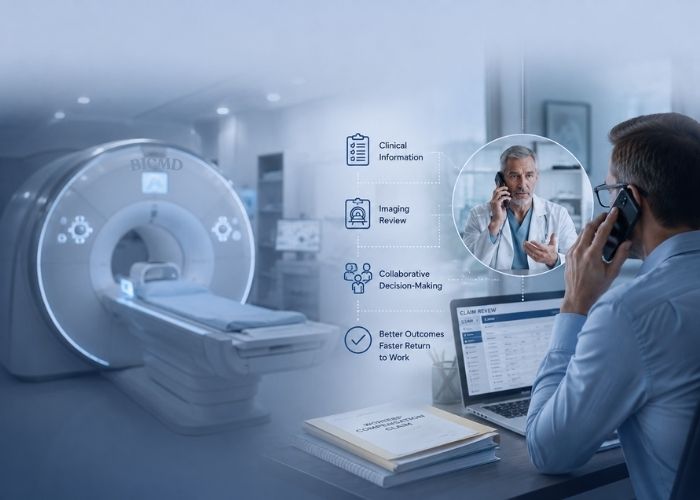
Often an MRI can reveal what is happening inside the body, but it doesn’t explain the entire injury on its own. To make the best medical decision, the specialist reviewing the imaging should obtain and review key information such as:
- The injured worker’s description of how the injury occurred
- Physical examination findings
- The timing of symptom onset
- Functional limitations
- Prior medical history
- The patient’s response to conservative treatment
Looking at the complete clinical picture helps determine whether MRI findings explain the patient’s symptoms or whether additional evaluation or testing is needed.
Not Every MRI Finding Explains the Workers’ Compensation Injury
One of the most common misconceptions in workers’ compensation is that every abnormal MRI finding is the reason for the patient’s pain.
At BICMD, we often find that is simply not the case.
For instance, many adults have asymptomatic rotator cuff tears or other conditions that have not caused them any problems. Conditions like a lumbar disc bulge, meniscal tears, and arthritic changes may have developed over time and had existed long before a workplace injury occurred.
The key question is not: “Is there something abnormal in the MRI?”
The better question is: “Does this MRI finding match the patient’s injury, symptoms, and physical examination?”
Our fellowship-trained and board certified experts at BICMD can answer that question. Our Best In Class physicians have years of clinical expertise and can offer more information than a simple imaging report.
MRI Can Help Clarify the Nature of a Workplace Injury
When an MRI report is reviewed in the proper clinical context, it may help determine whether a condition appears to be:
- An acute traumatic injury (Age of Injury)
- A chronic degenerative condition
- An aggravation of a pre-existing injury
- An incidental finding unrelated to current symptoms
Those distinctions are important because they often influence:
- Treatment recommendations
- Surgical decision-making
- Return-to-work timelines
- Overall claim strategy
For workers’ compensation professionals, greater clinical clarity often leads to more confident claim decisions.
Timing Matters in Workers’ Compensation Tests and Imaging
The timing of an MRI can influence what it reveals. In the early stages after an injury, imaging may demonstrate signs of recent trauma such as bone bruising, soft tissue swelling, inflammation, or bleeding. As healing progresses, many of those findings naturally diminish.
This doesn’t mean every injured worker needs an MRI right away. Instead, it means getting the scan when it’s medically appropriate. That way, physicians have the right information to guide treatment and support better claim decisions, at the right time. The goal is to gather meaningful information, not simply order more tests.
Better Imaging Leads to Better Decisions
For claims professionals, an MRI isn’t just about confirming a diagnosis. It can also help answer important questions, including:
- Does the imaging support the reported mechanism of injury?
- Is surgery likely to benefit this patient?
- Are the MRI findings consistent with the patient’s reported symptoms?
- Is additional testing or specialist physical evaluation needed?
- Are there signs of a pre-existing condition that should be considered?
- What is the age of this injury?
When those questions are answered early in the process, claims often move forward with greater efficiency and with fewer unexpected detours.
MRI Is Most Valuable When Interpreted by the Right Specialist
Even the highest-quality MRI has limitations if it isn’t interpreted within the complete clinical picture. That is why BICMD has experienced, board-certified, fellowship-trained orthopedic specialists that evaluate imaging. They also consider the patient’s history, functional limitations, and exam findings.
At BICMD, imaging is never viewed as a standalone report. It’s one component of a comprehensive clinical evaluation designed to support objective, evidence-based decision-making throughout the life of a workers’ compensation claim.
Better Clinical Information Supports Better Workers Comp Outcomes
An MRI doesn’t make decisions, it provides information. When interpreted by the best orthopedic specialist and considered alongside the entire clinical picture, advanced imaging can improve diagnostic accuracy. Accurate MRI interpretation can also guide appropriate treatment and help claims professionals make better-informed decisions.
For workers’ compensation, the goal isn’t simply to identify what’s visible on an MRI. It’s to understand what those findings mean for the injured worker, the treatment plan, and the path toward recovery and return to work.
Contact BICMD For an Expert MRI Review
An MRI is only as valuable as the expertise used to interpret it. BICMD helps claims professionals make confident, evidence-based workers’ compensation decisions through independent orthopedic evaluations, fellowship-trained specialists, and coordinated clinical guidance designed to improve outcomes and support a timely return to work.